Ashbury with Compton Beauchamp CE Primary School
Writing
What do we want children to learn?
At Ashbury, we promote high standards of literacy and language by equipping pupils with a strong command of the spoken and written word. We strive for every child to learn and develop the fundamental skills of writing, enabling every child to express themselves in their own unique style. We believe in a writing curriculum that inspires children to gain pleasure and develop confidence by crafting pieces for genuine purposes and real-life audiences.
The National Curriculum shapes our Writing curriculum and our aims ensure that all children:
- Acquire a wide vocabulary, an understanding of grammar and knowledge of linguistic conventions of reading, writing and spoken language
- Appreciate our rich and varied literary heritage
- Write clearly, accurately and coherently, adopting their language and style in and for a range of contexts, purposes and audiences
- Use discussion in order to learn; they should be able to elaborate and explain clearly their understanding and ideas
- Are competent in the arts of speaking and listening, making formal presentations, demonstrating to others and participating in debate.
How do we teach Writing?
Drawing Club (EYFS)
Early Years children take part in Drawing Club four times per week - an imaginative literacy approach taken from the Early Years guru Greg Bottrill, where they explore stories through drawing, mark-making and "codes" (marks, letters and numbers that influence the story). Books are carefully chosen over a two-year cycle, with flexibility based on the cohort's interests and needs.

English in KS1
Year 1 - Super Sentence Model
In Year 1, we use an adapted "Super Sentence" model to build strong foundations in early writing. Children learn to:
- internalise a model sentence
- rehearse it aloud
- explore vocabulary
- practise key tricky words
- understand capital letters and full stops
- edit simple sentences
- write the sentence accurately with developing handwriting
This is delivered through a clear weekly structure:
Day 1 - Imagine & Internalise
Day 2 - Which Words?
Day 3 - Successful SPAGhetti
Day 4 - Editing Eyes
Day 5 - Write it Right!
This ensures children build confidence and accuracy before moving to more extended writing later in the year. When secure, Year 1 children begin accessing aspects of the Hampshire Writing Model ready for Year 2 expectations.
Year 2 - Hampshire Writing Model
Year 2 children follow the Hampshire Writing Model, engaging in rich reading and writing experiences. This includes:
- text-driven units (e.g. Paddington)
- reading as a reader and reading as a writer
- exploring vocabulary through "super 6" words
- sentence-level skills and grammar
- drafting, editing and improving writing
- creating outcomes such as posters, stories or reports
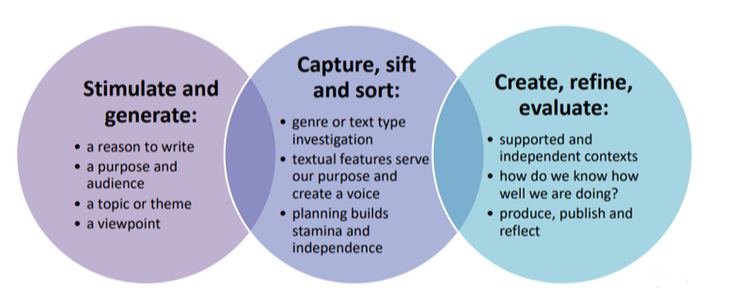
In Key Stage 2, children continue to follow the Hampshire Writing Model. This model and journey allows children to become creative explorers and reflective publishers. Our writing journey is taught in the following sequence:
- Stimulate and Generate
- Capture, Sift and Sort
- Create, Refine and Evaluate
Stimulate and Generate- Read as a Reader
In the 'Stimulate and Generate' phase, children are introduced to their new stimuli and complete complementary activities to enable them to engage and understand it. There is opportunity for children to write at length through 'Apprentice Writes' - chances for the children to write in a style they have used recently but using the new stimuli.
Capture, Sift and Sort- Read as a Writer
In the 'Capture, Sift and Sort' phase, children are taught and provided with opportunities to use new punctuation and grammar techniques. This part of the journey begins by looking at a WAGOLL (what a good one looks like). There are opportunities for children to write at length through 'Site of Application Writes' - chances for the children to apply their newly taught punctuation and grammar in a writing style that will support them with their final write.
Create, Refine and Evaluate- Write as a Writer
In the 'Create, Refine and Evaluate' phase, children will write their final piece of work. This will begin with a planning session where children are encouraged to think about the purpose, audience, viewpoint and form of the piece. The rest of this stage provides opportunity for children to write at length, including time devoted to editing. Children will evaluate their final work once they have published their final piece.
On leaving Ashbury with Compton Beauchamp CofE Primary School, children will:
All children in our school will be provided with a ‘toolkit’ to become lifelong learners and linguists through our teaching of the English curriculum. Wherever possible, children will be given the opportunity to reflect on their writing particularly through the use of purpose led writing. Children will be able to take into account their reader when writing and the impact this should have on their intended audience. A refining process is embedded into English through both editing and improving, this provides children with the means to understand how vital this process of writing is whilst also building on their resilience. Not only will children develop as writers through specific English lessons but will be provided with opportunities to write creatively curriculum wide. Children will have a positive attitude towards Writing and will be able to use learnt communication skills to contribute to the wider community. Children will be thoughtful, reflective writers who are able to write for different purposes effectively and are able to independently review and improve their own work.
Contact Details Ashbury Primary School, Ashbury, Oxfordshire, SN6 8LN
Ashbury Primary School, Ashbury, Oxfordshire, SN6 8LN